





As a homeowner in the Los Angeles area, the question of whether you should or should not retrofit your home in case of an earthquake may have crossed your mind. Of course, when considering this, more questions may have popped up.
Is a seismic retrofit necessary?
Can I get away with not doing this?
How much is this going to cost, like really?
While tackling these questions, we’ll take a look at the need, risks and costs associated with earthquake retrofits. *An earthquake retrofit is also called a “seismic retrofit,” “brace and bolt retrofit,” a “bolt down,” or “foundation bolting.”
Your home may be vulnerable to damage during an earthquake.
There are more than one million vulnerable, older homes in high-hazard earthquake areas across California. Many of those homes are in and around the city of Los Angeles because a large number of these older homes were built before more appropriate building codes were in place. In a seismic retrofit, we’ll help strengthen the structure of your home by bolting the house itself to the foundation it rests upon. This will help make it more resistant to shifting and structural damage during an earthquake. Here are a few signs that may point to the need for a seismic retrofit.
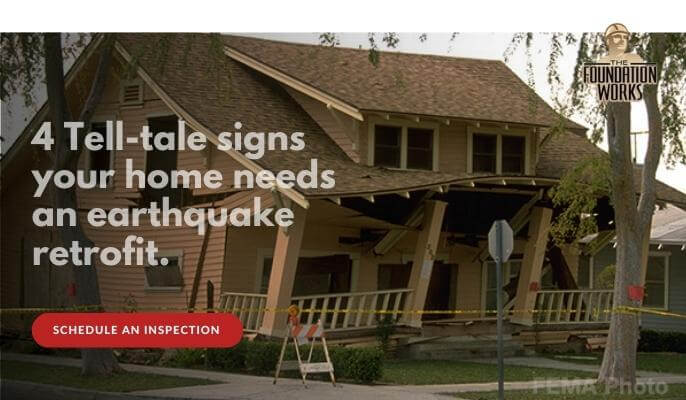
1. If your house was built before 1980, an earthquake retrofit will bring it closer to current codes and standards.
The California Earthquake Authority (CEA) recommends older homes (those built before 2000), to consider a seismic retrofit. If your home was built before 1980, which was before many contemporary earthquake building codes were put into place, there’s a chance you may qualify for a grant to help cover the cost of a seismic retrofit.
The EBB (Earthquake Brace and Bolt Program) offers grants of up to $3,000 to qualified homeowners with eligible houses in a select number of higher-earthquake-risk ZIP Codes. You can find out more about the EBB program on its website.
2. You may need a seismic retrofit if your older home has a crawl space.
Was your older home built on a raised foundation, meaning you have steps up to the first floor and or an area underneath the first floor (a crawl space)? As an EBB contractor, we’ve completed more than 1,300 earthquake brace and bolt projects for homeowners in the Los Angeles area and have seen numerous homes with raised foundations that likely lacked the support needed to withstand an earthquake.
Due to the fact that many homeowners cannot access the areas beneath their homes, don’t want to, or don’t know what to look for to determine if their house is bolted correctly, calling in a structural engineer or foundation repair expert is highly recommended. We perform free foundation inspections for owner-occupied homes to see if your home needs an earthquake retrofit, so you can contact us to schedule an inspection if you ares of Southern California that we currently service.
3. The post and pier assembly beneath your home has been weakened or shifted.
If you have not accessed the area beneath your home, you may not know what exactly is holding up your house. Generally, if your home has a post and pier foundation system, there will be several wooden posts on top of concrete piers that bear the weight of much of its structure.
Oftentimes, our inspectors find severely weakened post and pier assemblies due to water exposure, improperly installed posts, or posts that have been moved or removed by other home repair professionals. As part of upgrading the seismic preparedness of a foundation system, the post and pier assemblies can be repaired, replaced, and well secured as a further measure against the forces of seismic activity.
4. If you have a dwelling space above your garage that lacks structural soundness (a soft story building), your home may need earthquake retrofitting.
According to the California Earthquake Authority, earthquake retrofits of single-family houses that have a living space over a garage, or “soft story,” are needed because, without reinforcement, the home is more prone to potential collapse during an earthquake. A soft-story seismic retrofit strengthens the otherwise weak structure around the garage door and ground floor walls of the house so that it can better withstand seismic forces.
Do you really need an earthquake retrofit?
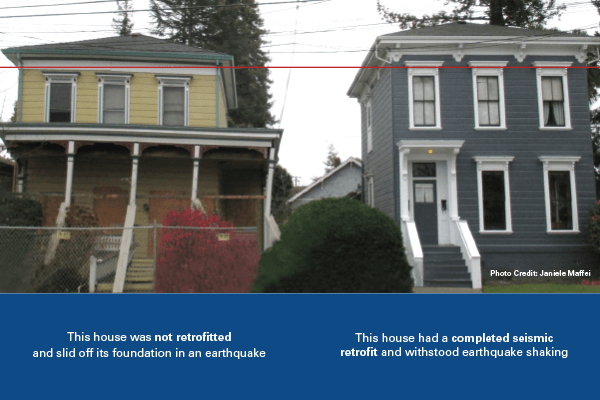
You can possibly get away with not doing a retrofit, but it may cost you. A recent study by the Pacific Earthquake Engineering Research Center> stated that owners of retrofitted houses can save between $10,000 and $200,000 in repairs and temporary relocation costs resulting from a major earthquake by bracing and bolting their homes with a seismic retrofit.
On the contrary, a retrofit on a raised foundation may only cost as little as $3,000 depending on several factors including the square footage of the home, if it’s one or two stories, the construction material of the raised foundation (concrete, brick, or river rock), etc. We believe it pays to be proactive, not reactive when it comes to earthquake preparedness.
If your home was retrofitted in the past, it helps to get a second opinion.
During our more than two decades of foundation inspections, roughly 80% of the homes we’ve inspected in LA County of “post 1994 retrofits” have had some or many aspects of that work performed sub-standardly. Unfortunately, many of these homes have signed off city permits for this work and yet the standards were not met. Regrettably, this will someday catch property owners off-guard, resting in this assumption that all is well and done right regarding the seismic readiness of their home.
This leaves us finding only about 20% of the inspections of “post 1994” inspections to have been properly and fully retrofitted. If your foundation retrofit is sub-standard in some way, we will be able to provide you with a recipe for correction to resolve that deficiency and help protect your home from loss in any future earthquakes.
If you are unsure if your home is ready for the next earthquake (The United States Geological Survey (USGS) predicts a 93 percent chance that a 6.7 or greater earthquake will strike Southern California, based on a 30-year period) give us a call and we’ll come and take a look for you.
During the inspection, we’ll assess your home’s condition and provide you with a summary of findings within 24-48 hours. Schedule an inspection today!
